
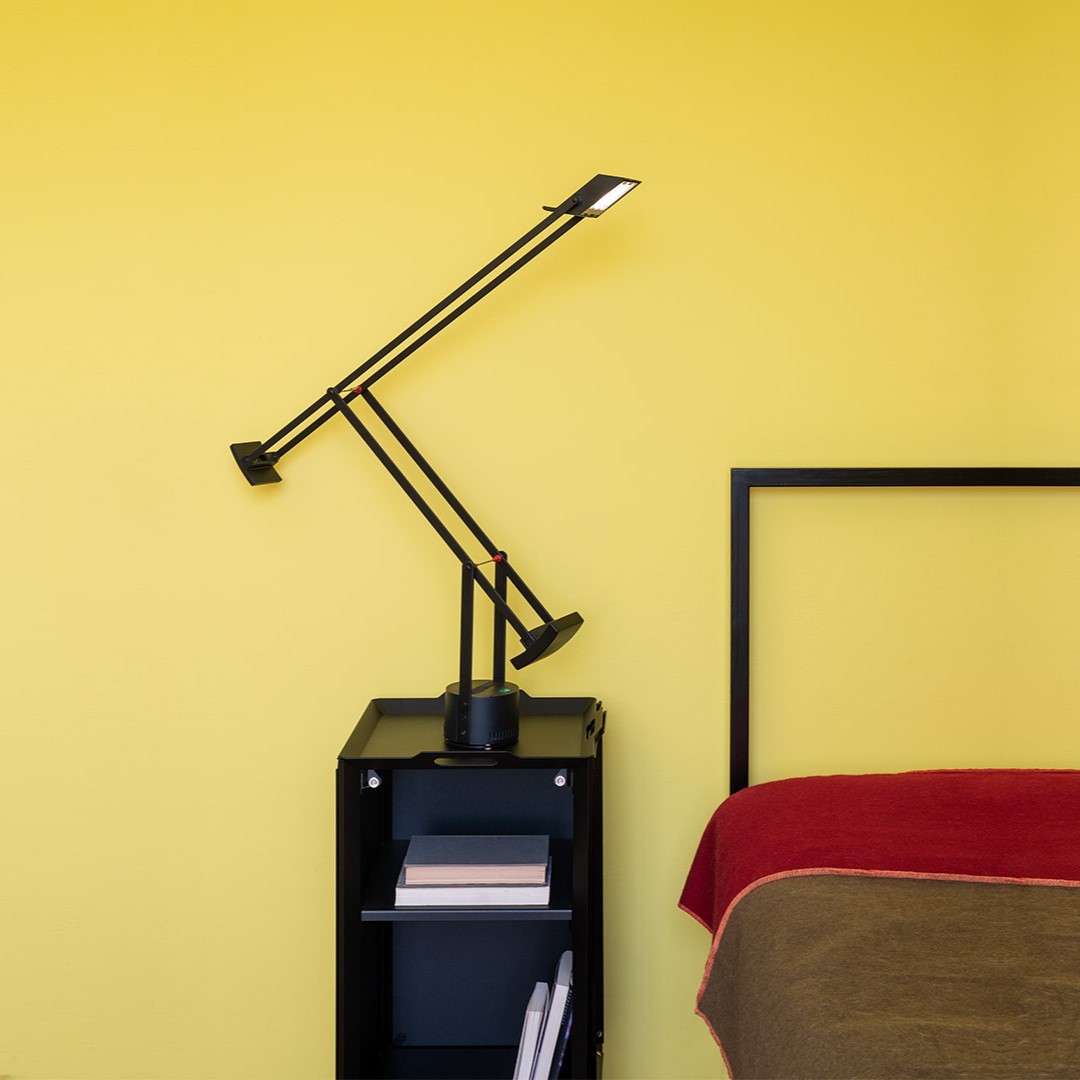
The Tizio table lamp still feels a little bit impossible, which is probably why it has stuck around for so long. Designed by Richard Sapper in 1972, it takes the usual desk-lamp logic and pares it down to something much leaner: two counterweighted arms, a compact head, a small base, and almost no visual clutter. The first thing you notice is the line of it. All those thin black arms and sharp angles make the lamp feel more like a drawing in space than a piece of hardware sitting on a desk.
What makes Tizio so satisfying is that the engineering is also the look. The adjustable aluminum arms conduct electricity themselves, which eliminates the need for extraneous wires and keeps the silhouette remarkably clean. The counterweights let the lamp move with a push or pull of the hand, then stay put once it lands where you want it. That means the drama of the shape is not just for show. It is the mechanism, out in the open, doing its job beautifully. Artemide also notes the small reflector and concentrated light output, which helps explain why the lamp feels so precise in use. It is not trying to bathe the whole room in glow. It is there to direct light exactly where it is needed.
On a desk, Tizio brings a kind of focused calm. It looks especially good in spaces that lean graphic, minimal, or a little bookish, but it never feels sterile because the movement gives it personality. You adjust it once and suddenly it feels almost alive, poised mid-gesture. There is a reason it ended up in MoMA’s permanent collection and became one of Artemide’s best-known designs. It solves a technical problem with unusual clarity, then turns that solution into its whole visual identity. Smart, exact, and still a little radical.
Designed by Richard Sapper for Artemide