
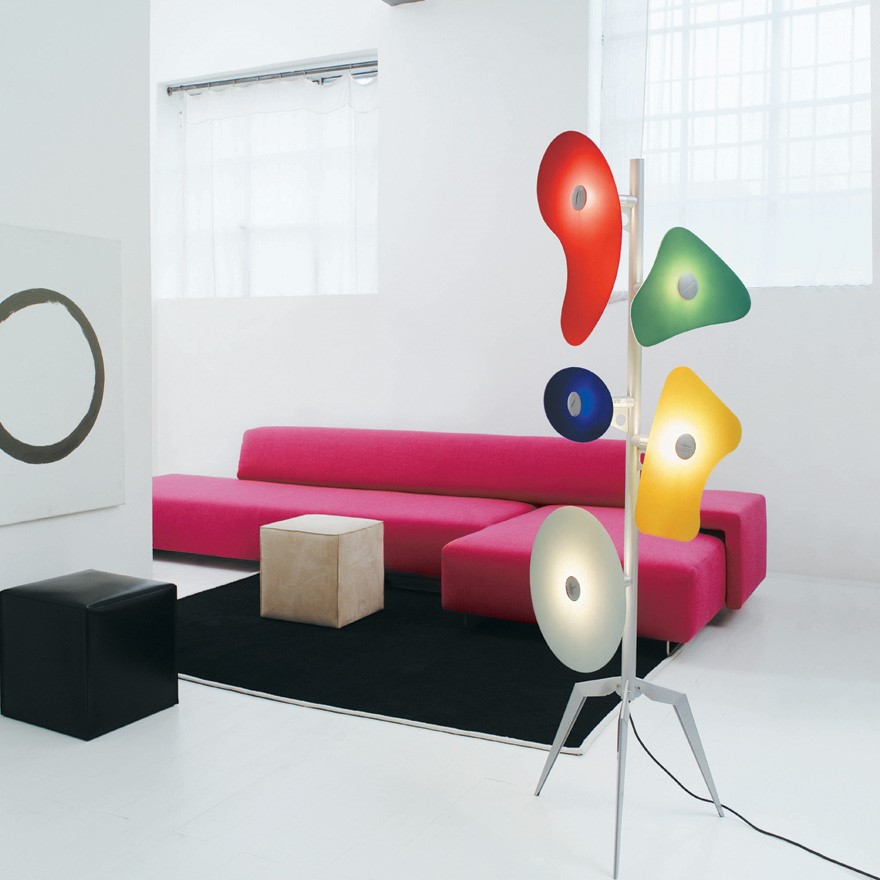
The Orbital floor lamp does not ease its way into a room. It arrives. Designed by Ferruccio Laviani in 1992, it stacks five irregular glass shapes along a slim tripod frame, turning color, light, and outline into one tall sculptural gesture. In the multicolor version especially, each diffuser feels like its own character: red, green, blue, yellow, white. Together they read less like a conventional lamp and more like a small illuminated composition standing in the corner. That is the fun of it. It is expressive without tipping into chaos.
What makes Orbital so memorable is the tension between the frame and the glass. The structure is lean and architectural, just varnished metal and a straightforward tripod base, while the diffusers are satin-finish glass in five different shapes and sizes. Those asymmetrical forms keep the lamp from ever feeling static. Even switched off, it has rhythm. Switched on, the glass softens and brightens, and the whole piece starts acting like a graphic sign in space, which is very much the point of the design. Foscarini describes it as a project with an unmistakable graphic and luminous presence, and that really does capture the mood.
This is the kind of floor lamp that works best when it has room to be seen. In a living room, it can anchor a corner without relying on bulk. In a more minimal interior, it becomes the color and shape. In a more layered space, it holds its own by sheer silhouette. The lamp uses five E14 bulbs and casts diffused light, so the effect is more atmospheric than task-focused. At a little over 10 kilograms, it also has enough physical weight to feel grounded despite all that visual play. It is sculpture, yes, but useful sculpture. A rare category, and a very good one.
Designed by Ferruccio Laviani & Manufactured by Foscarini