
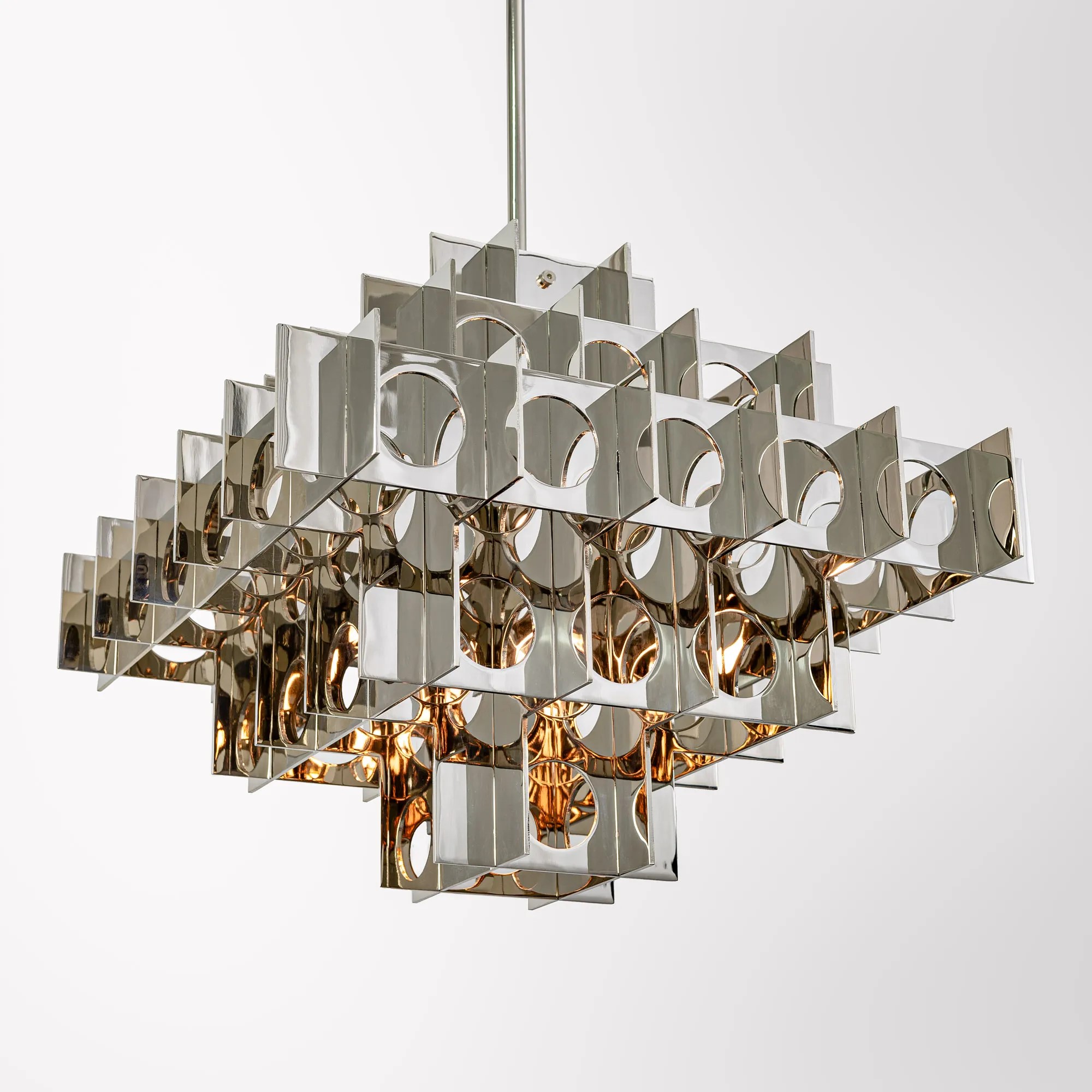
The Tenfold Chandelier has real presence, but it is not heavy-handed about it. Built from a dense arrangement of reflective metal panels, it forms a broad, stepped volume that feels somewhere between architecture and illusion. The repeated square planes, each punctured with circular openings, create a layered grid that shifts constantly as you move around it. From one angle it reads as a sharp geometric mass. From another, it starts to flicker and open up. That changing read is a big part of its appeal.
What makes this piece so striking is the way order and reflection work together. The structure is disciplined, almost modular, but the polished metal keeps the fixture from feeling static. Light bounces across the surfaces, catches in the cutouts, and folds back into the interior, so the chandelier never looks exactly flat or fixed. It has depth, but also shimmer. Precision, but with a bit of visual chaos mixed in. The circular voids help with that too. They interrupt the grid just enough to keep the form from becoming too severe, giving the whole piece a more dynamic rhythm.
This is a chandelier that wants room around it. Over a dining table, it would feel like a suspended centerpiece with real architectural weight. In a larger entry, it could set the tone immediately. It would also work in a living space that can handle something sculptural overhead, especially where the reflective finish can catch daylight and change through the day. Despite the complexity, the shape still feels controlled. Nothing loose, nothing accidental.
There is a slightly retro-futurist energy here, but it does not lean on nostalgia. It feels more like a study in repetition, reflection, and structure, taken just far enough to become dramatic. A chandelier with pattern, polish, and a very clear sense of itself.
This piece is designed and manufactured by Luft Tanaka Studio